Baby wearing is said to make babies smarter, calmer, more attentive, less colicky and more likely to develop healthy sleep habits than their counterparts in strollers.
 |
My son and I using a ring sling at 3 weeks. at 3 weeks. |
Babies are carried in wraps and other types of carriers throughout the world from birth until when they start walking, and this is known as the "in-arms phase."
Anecdotally, parents agree it makes life easier to always know where the baby is, and they are able to use both hands to meet life's other demands. It has also been said to lessen postpartum depression and improve infant heath and mortality.
Anecdotally, parents agree it makes life easier to always know where the baby is, and they are able to use both hands to meet life's other demands. It has also been said to lessen postpartum depression and improve infant heath and mortality.
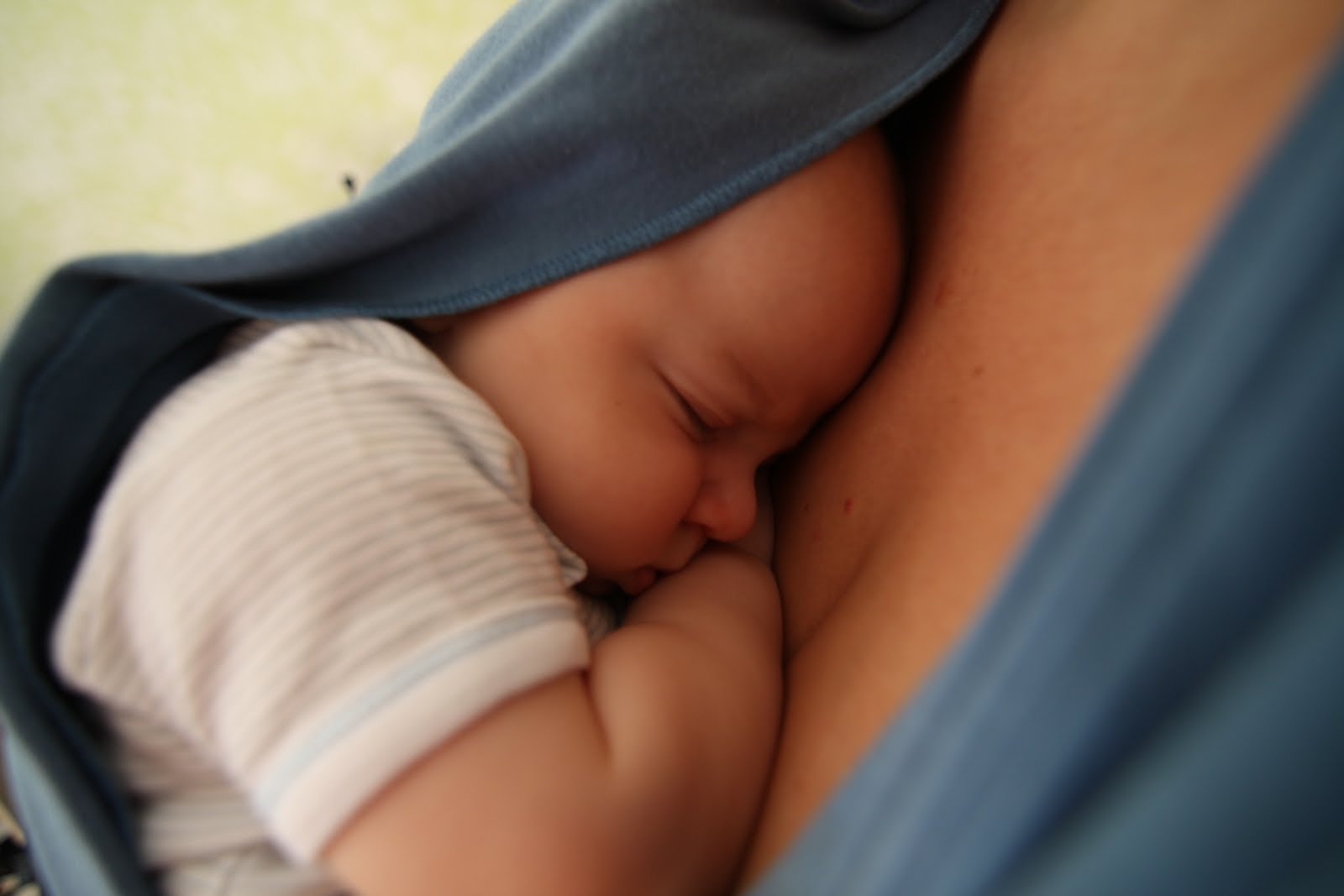 |
My son asleep in the Moby  at 3 months. at 3 months. |
To wear your baby, first you need to choose a carrier. There has been a glut of carriers on the market lately, and they fall into a few categories. I have tried many types of carriers, looking for the perfect fit. This "perfection" has changed many times, with a pouch  being perfect from Day 2 (6 pounds) to 10 pounds, then a Moby Wrap
 through six months, then an Ergo
  and Mei Tai
 on the front and back through 2 years, and now my son will only go into the hip carrier
 or Ergo
  (he will be 3 in August).
being perfect from Day 2 (6 pounds) to 10 pounds, then a Moby Wrap through six months, then an Ergo and Mei Tai on the front and back through 2 years, and now my son will only go into the hip carrier or Ergo (he will be 3 in August). |
At 8 months and snug in the Ergo  at a family holiday gathering (the Ergo suck pads are homemade). at a family holiday gathering (the Ergo suck pads are homemade). |
Pouch and Ring Slings
Pouch slings are a fixed size. They fold in half, fit over one shoulder, and the baby sits in the pouch. These accommodate newborns nicely, and babies can often nurse in them. As babies grow, how the baby is worn changes but many caregivers find them useful. Toddlers straddle the body from the opposite hip. These come in fabrics like hard cotton and fleece, and some have padding on one side. Popular brands include New Native and Seven Slings. The advantage of these is that they are small enough to tuck into a diaper bag, and can be used in a variety of positions as baby grows. The disadvantage is that they come in different sizes, so it is difficult to share a carrier between caregivers or when a Mama changes size, the carrier may not fit any more.
and Seven Slings. The advantage of these is that they are small enough to tuck into a diaper bag, and can be used in a variety of positions as baby grows. The disadvantage is that they come in different sizes, so it is difficult to share a carrier between caregivers or when a Mama changes size, the carrier may not fit any more.Ring slings are used the same, but the rings allow the user to change the size The Dr. Sears' Balboa Baby adjustable sling is a popular brand, as is the Maya Wrap
 .
.
is a popular brand, as is the Maya Wrap. When shopping for these, keep in mind how thick the fabric is when not in use. This translates into how much space it will take up in a diaper bag and how heavy it will be during different seasons.
In my experience, both were useful, but the ring sling was even more useful than the standard pouch, although the standard pouch carrier was useful as I got used to baby wearing, since I didn't need to adjust it every time. It was nice to slip the pouch on and pop the baby in, especially when we went anywhere where I thought people would ask to hold the baby and I wanted to keep him close. I preferred the other, and liked being able to share the ring sling with my partner and use it as I got smaller. Having the weight on one shoulder got a bit heavy after carrying the baby for a while, and I stopped using it almost entirely after about the baby hit about 10 pounds and I discovered the wrap carrier.
 |
| At 2 months and at a work function, my son could sleep through anything when snuggled in the Moby. I wore him for hours in the Moby, since it distributed the weight evenly and let me pay attention to him without really stopping to pay attention to him. |
Wraps
Wrap carriers are a bit daunting at first, since they are made from yards and yards of material and you have to tie it on yourself then tuck the baby inside. But watching the video and reading the instructions is worth it, because once you get it on the right way, the baby is attached in such a way that the weight just falls off. It is evenly distributed between both shoulders and both hips, and the baby feels snugly swaddled in close to the caregiver. A fussy baby quiets once inside, and, like all the carriers, a mama in motion with baby in carrier reminds them of the comfort of the womb and they calm right down, and often fall asleep. Many mamas put the Moby (or other wrap like the Sleepy Wrap ) on after a light layer in the morning, and keep it on all day, popping baby in and out as needed, and layering other clothing on top.
(or other wrap like the Sleepy Wrap) on after a light layer in the morning, and keep it on all day, popping baby in and out as needed, and layering other clothing on top.Downfalls of wrap carriers are the learning curve to get them on right, and I found that only one of the positions, baby in front facing in, worked for us. Many positions are advertised and shown on their instructions, and my son and I both loved the one that worked for us. We actually used this carrier so much that I got a second one so we could wash one and wear one.
Unfortunately, he got too tall to tuck his head inside anymore around six months, so we had to retire it (sadly), and transition to a soft structured carrier.
Unfortunately, he got too tall to tuck his head inside anymore around six months, so we had to retire it (sadly), and transition to a soft structured carrier.
 |
| My son took many naps while I went about my business (shown here in San Diego at 9 months and with the sleeping hood of the Ergo up). My friend is using a Baby Bjorn, which I do not include on this list because some of the models do not give adequate support to the mother, placing all weight on the shoulders. Some models also are formed so the baby's weight is on the spine instead of placing the baby in a seated position like the Ergo does, thus being less than ideal for baby's physical development. |
Asian Carriers (ABC Carriers), Soft Structured Carriers, and Hip Carriers
Asian baby carriers include the Onbuhimo, Mei Tai, Podeagi, and Bei Bei. Soft structured carriers like the Ergo , Boba
  and Beco
  are take-offs of the Mei Tai with buckles and pockets and other add-ons. Hip carriers like the Scootababy
  are also Mei Tai take-offs. They are mostly a panel of fabric with a strap at each corner-- two for the waist and one for each shoulder, to be worn backpack-style or crisscrossed in front (or back or side).
, Boba and Beco are take-offs of the Mei Tai with buckles and pockets and other add-ons. Hip carriers like the Scootababy are also Mei Tai take-offs. They are mostly a panel of fabric with a strap at each corner-- two for the waist and one for each shoulder, to be worn backpack-style or crisscrossed in front (or back or side). |
At 11 months and in the Ergo at another family function. My son was able to stay part of the action without being handled more than he was ready for, as he felt safe and secure on Mama. Notice his slightly younger cousin on his Mama, also in an Ergo , but carried in the hip way instead of front way. , but carried in the hip way instead of front way. |
All of these carriers have a main body panel piece where the baby sits. They are a fixed size and the baby's legs straddle the fabric. The Bei Bei and Podeagi are different in that they have a main piece that is more of a blanket, and needs to be wrapped around the baby. All of them have shoulder straps of a fixed width, and most are padded. The Mei Tai  and all of the soft structured carriers that are its knock-offs have waist bands. The Mei Tai and all of the soft structured carriers that are its knock-offs have waist bands. The Mei Tai 's waist is secured with a knot, and the soft structured carriers use webbing and a plastic buckle. The soft structured carriers' buckle allows for less extra fabric, although it is nice to be able to tie the Mei Tai 's waist is secured with a knot, and the soft structured carriers use webbing and a plastic buckle. The soft structured carriers' buckle allows for less extra fabric, although it is nice to be able to tie the Mei Tai waistband in front or back. The Onbuhimo, Bei Bei, and Podeagi's top shoulder straps end up being tied in such a way to allow the hips to take some of the weight of the baby (unless you are pregnant and tie them above your belly instead). waistband in front or back. The Onbuhimo, Bei Bei, and Podeagi's top shoulder straps end up being tied in such a way to allow the hips to take some of the weight of the baby (unless you are pregnant and tie them above your belly instead). |
| At 18 months and in a homemade Onbuhimo Asian-Style carrier. This and the homemade Mei Tai were nice to hold the baby on front or back, and also distributed the weight nicely. The padded shoulders and hips of the Mei Tai, as well as the ability to switch it from front to back easily and ride the baby higher and tighter on the back made this a favored carrier. |
The advantage of the soft structured carriers over the traditional ABCs are the add-ons like buckles, pockets, and sleeping hoods. My favorite ended up being the Ergo, although I washed mine a few too many times and the padding wore a bit thin. I liked the fit for me and my son, and the pocket was well-placed and sleeping hood covered just right. The chest strap really helped us feel secure when using it. I also liked the ease of switching from front to back. A downfall of this is that it is not meant to be used until 15 pounds, although they make an infant insert  so the baby can be swaddled inside before this. I didn't try it, but hear it feels less secure and Mamas feel like they need to keep a hand on the carrier to keep baby inside (and that defeats the point, doesn't it?).
, although I washed mine a few too many times and the padding wore a bit thin. I liked the fit for me and my son, and the pocket was well-placed and sleeping hood covered just right. The chest strap really helped us feel secure when using it. I also liked the ease of switching from front to back. A downfall of this is that it is not meant to be used until 15 pounds, although they make an infant insert so the baby can be swaddled inside before this. I didn't try it, but hear it feels less secure and Mamas feel like they need to keep a hand on the carrier to keep baby inside (and that defeats the point, doesn't it?).Next favorite of the soft structured carriers for me was the Scootababy.  It only has one shoulder strap and a waist band, although the shoulder is made of fleece and hugs the shoulder, thus keeping the weight more securely on the bones rather than the muscles, thus lightening the load. It is easier than using another type of carrier which has to be made into the hip position because of this shoulder pocket and because it is already there. This carrier would benefit tremendously from a pocket (even a small cell-phone and credit card sized one).
It only has one shoulder strap and a waist band, although the shoulder is made of fleece and hugs the shoulder, thus keeping the weight more securely on the bones rather than the muscles, thus lightening the load. It is easier than using another type of carrier which has to be made into the hip position because of this shoulder pocket and because it is already there. This carrier would benefit tremendously from a pocket (even a small cell-phone and credit card sized one).The traditional ABCs are very adjustable, though, and worth a try. All of the carriers of this style really help in the 20 to 40 pound range of babies and toddlers. The Mei Tai is my favorite of these, as we always felt snug in it. I never got the sleeping hood quite right, though, and am looking forward to trying my newly innovated version. I didn't love using the Onbuhimo, since putting it on requires a bit of coordination to hold the baby steady in the carrier while threading the shoulder straps through the rings, but my guess is that it would improve with practice. With the next baby, I may give the Bei Bei and Podegai a try, although I am pretty happy with my current carrier selection. I like the idea of them being able to keep the legs together, and having the carrier double as a blanket when not in use. I am not sure if the extra fabric would just get hot, though.
 |
| At just shy of 2 years old, we switched to the Scootababy hip carrier. You can see my son staying close to me (and allowing me both hands) as he goes about his toddler business. |
All in all, whatever carrier works for you and your baby is the one that is best for you! There are so many out there to choose from that you are sure to find one that is right for you. Or maybe, like me, you will find the changing advantages of the different types as you and your baby change.
References/ Further Reading:
"The Latest in Strollers? Mom and Dad," NY Times, March 10, 2010.
The Baby Book by Sears and Sears, 1992, or their website.
by Sears and Sears, 1992, or their website.The Continuum Concept  by Jean Liedhoff, 1975.
by Jean Liedhoff, 1975.Our Babies, Ourselves by Meredith Small, 1998.
by Meredith Small, 1998.The Happiest Baby on the Block by Harvey Karp, 2002.
by Harvey Karp, 2002.To make own, see Jan Andrea on the web.


 (FOE) as a binding and I didn't stretch it at all. I like how the fabrics compliment each other and am happy with the weight of the finished product. I am hoping to use the pad as an infant


 (or
(or  diapers
 diapers

 leg warmers
 )
) nonwaterproof snapping training pant and doubling insert
 )
)

